Snap Compliance
Contact us

Language

EN ES PT
Start free
Regulatory framework · Costa Rica

Law 7786 compliance in Costa Rica, with the evidence ready for your supervisor

For banks, cooperatives, brokerages, pension fund operators, insurers and every obligated entity under articles 14 to 15 quater: what the law requires, which rules apply to you, and how Snap Compliance turns those obligations into a program that works.

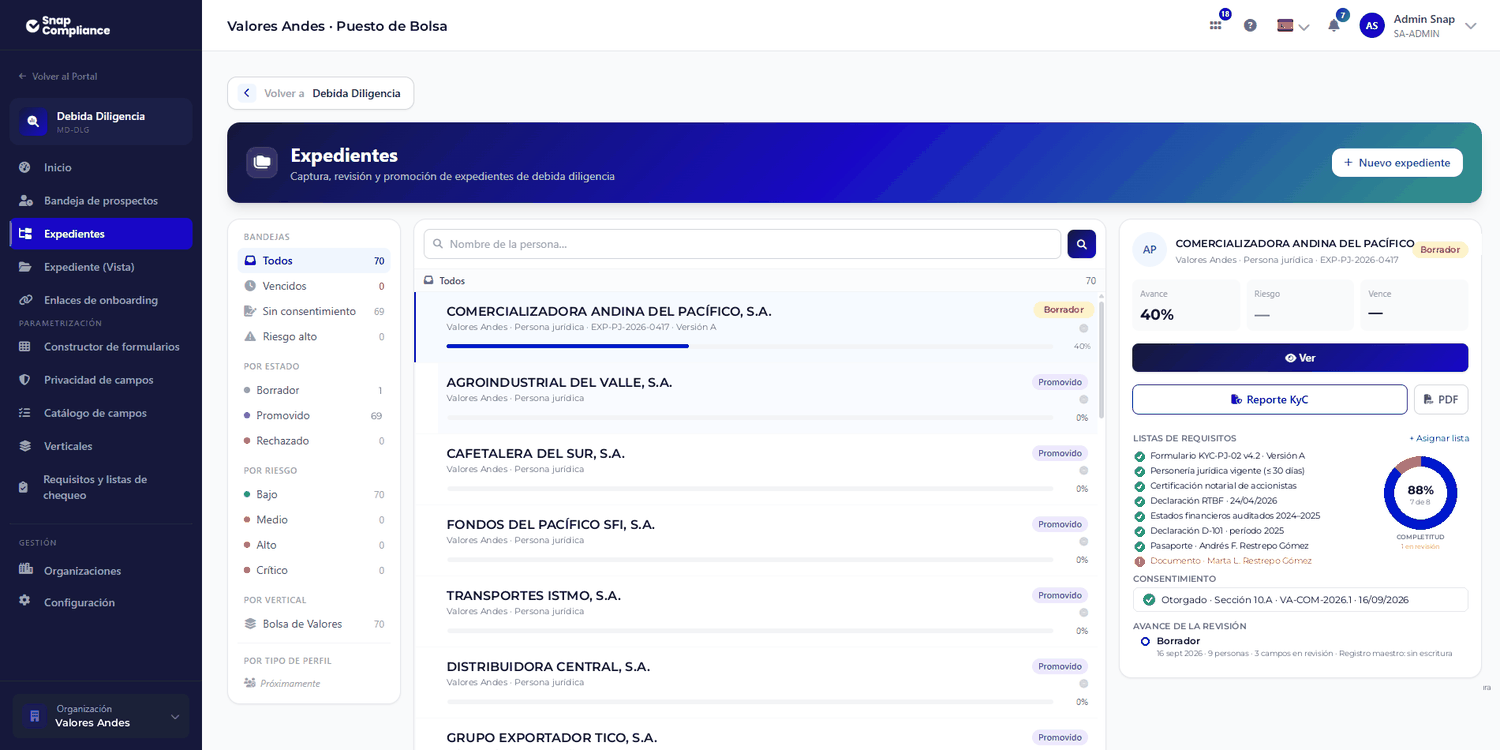
Due Diligence module inbox showing the requirement list and completeness percentage, anonymized data
Customer files with their requirements —corporate standing, notarized shareholder certificate, RTBF filing— and each one's progress. Due Diligence

At a glance

The framework in six pieces

Framework law

Ley 7786

Costa Rica's law on narcotics, related activities, money laundering (legitimación de capitales) and terrorist financing. Its current text comes from the comprehensive reform made by Law 8204, which is why many still call it by that number.

Financial supervision

CONASSIF

Directs SUGEF, SUGEVAL, SUGESE and SUPEN, and approves the regulations that apply the law in each market.

Prevention regulations

CONASSIF 12-21 · SUGEF 13-19

12-21 governs the financial institutions under article 14 (it used to be called Acuerdo SUGEF 12-21). 13-19 covers those under articles 15 and 15 bis.

Financial intelligence

UIF · ICD

The ICD's Financial Intelligence Unit receives suspicious transaction reports: through UIF Directo for article 14 institutions, and through UIF Reportes for those under articles 15 and 15 bis.

Beneficial ownership

Ley 9416 · RTBF

Legal persons declare their beneficial owners in the Transparency and Beneficial Ownership Registry run by the Central Bank. The regulatory threshold is a stake of 15% or more.

Personal data

Ley 8968 · PRODHAB

Governs the processing of the personal data that due diligence collects. The supervisory authority is PRODHAB.

Who is obligated

Five articles, five regimes

Law 7786 splits obligated persons across five articles. The article determines which rules apply and who supervises.

Art. 14

Financial institutions

Those regulated, supervised and overseen by SUGEF, SUGEVAL, SUPEN and SUGESE, plus every company in the financial groups those bodies supervise.

Prevention rules
Acuerdo CONASSIF 12-21
Supervisor
SUGEF · SUGEVAL · SUGESE · SUPEN

Art. 15

Financial activities outside the supervised system

Currency exchange and transfers; traveler's checks and postal money orders; substantial systematic fund transfers; management of funds, including trusts, by non-intermediaries; cross-border remittances; and credit card issuers and operators. They register with SUGEF, and registration is not a license to operate.

Prevention rules
Acuerdo SUGEF 13-19 · Acuerdo SUGEF 11-18
Supervisor
SUGEF

Art. 15 bis

Designated non-financial businesses and professions (DNFBPs)

Casinos; professional real estate buying and selling; dealers in precious metals and stones; non-profit organizations that send or receive money from high-risk jurisdictions; lawyers, notaries and accountants when acting for clients in real estate transactions, asset management or the buying and selling of legal persons; trust service providers; credit providers; and pawnshops.

Prevention rules
Acuerdo SUGEF 13-19 · DE 41016-MP-MH-MSP-MJP
Supervisor
SUGEF

Art. 15 ter

Notaries

When they take part in real estate transactions, manage client assets or are involved in buying and selling legal persons, they are supervised by the Prevention Area of the National Notary Directorate (Dirección Nacional de Notariado).

Prevention rules
DE 41016-MP-MH-MSP-MJP · DE 40959-MJP
Supervisor
Dirección Nacional de Notariado

Art. 15 quater

Virtual asset service providers

Businesses that exchange virtual assets for money or for one another, transfer them, safeguard them, or provide services tied to their issuance or offer. Law 10961 brought them in: they register with SUGEF, document their risk assessment, and apply due diligence, transfer controls and suspicious transaction reporting. CONASSIF sets the detailed conditions by regulation.

Prevention rules
Ley 10961
Supervisor
SUGEF

By sector

What each sector has to do

The law obligates by activity, not by industry: the article that applies to your organization determines which rules it follows and who supervises it.

Art. 14

Banks, finance companies and mutuals

State-owned commercial banks, banks created by special laws, private banks, non-bank finance companies and savings and loan mutual associations are article 14 institutions supervised by SUGEF.

  • They apply CONASSIF 12-21: a compliance committee chaired by a board member, a principal and a deputy compliance officer, internal audit with an annual program and an annual external ML/TF/PF audit.
  • They record cash transactions and transfers to or from abroad of US$10,000 or more —single or adding up within a calendar month— and report them to SUGEF within 20 calendar days after each month ends.
  • They feed SUGEF's Know Your Customer Information Center (CICAC) and, with the customer's authorization, consult it for their due diligence.
  • Before enabling services for anyone carrying out an article 15, 15 bis or 15 quater activity, they verify that it is registered with SUGEF, and they may not keep the relationship if the registration is not current: the law sanctions it with a fine of 0.5% to 2% of equity.
  • In a financial group or conglomerate, the obligations reach every company in it, and they can share a corporate compliance function.
Prevention rules
CONASSIF 12-21 · Ley 7786
Supervisor
SUGEF

Solutions for this sector

Art. 14

Securities market

Brokerage firms (puestos de bolsa), investment fund management companies and the other entities overseen by SUGEVAL are article 14 institutions.

  • They apply CONASSIF 12-21 under SUGEVAL's supervision: the same regulation that governs a bank, with a compliance committee, a principal and a deputy compliance officer, and internal and external audits.
  • Their monitoring alerts when a customer's transactions exceed the declared profile and, where applicable, when they are not consistent with the customer's investment capacity.
  • In non-financial and venture capital funds, due diligence on persons linked to the fund —tenants, sellers or buyers of its assets, construction companies, among others— follows SUGEVAL's specific guidelines.
  • If they receive their customers' funds in accounts at SUGEF-supervised institutions, their compliance officer can ask the counterpart there for information on cash transactions of US$10,000 or more, to meet their own reporting.
Prevention rules
CONASSIF 12-21 · Ley 7732
Supervisor
SUGEVAL

Solutions for this sector

Art. 14

Pension fund operators

Supplementary pension fund operators, supervised by SUPEN, are article 14 institutions.

  • They apply CONASSIF 12-21 under SUPEN's supervision, with a compliance committee, a principal and a deputy compliance officer, and internal and external audits, like the rest of article 14.
  • They rate every customer at least as high, medium or low risk, and update the customer's information according to that risk, at least every 60 months.
  • If they receive their customers' funds in accounts at SUGEF-supervised institutions, their compliance officer can ask the counterpart there for information on cash transactions of US$10,000 or more, to meet their own reporting.
Prevention rules
CONASSIF 12-21 · Ley 7523
Supervisor
SUPEN

Solutions for this sector

Art. 14

Insurance

Insurers, reinsurers and intermediaries are article 14 institutions, with SUGESE's own rules.

  • They apply CONASSIF 12-21 together with SUGESE's differentiated guidelines (Acuerdo SGS-A-0091-2022), which take precedence over the general rule where they are specific. Intermediaries are agents, insurance agencies and insurance brokerage firms.
  • The customer is the policyholder, the insured and the beneficiary. The beneficiary's identity must be verified no later than before the benefit is paid.
  • An annual premium under USD 1,000 or a single premium under USD 2,500 is an example of lower risk. Life insurance linked to investment funds, or single-premium contracts that generate returns, require considering enhanced due diligence.
  • The insurer reports to SUGESE cash transactions and cross-border transfers totaling US$10,000 or more in a month, including those made through its intermediaries. Intermediaries may exceptionally appoint, based on their risk analysis, a compliance liaison instead of a compliance officer.
Prevention rules
CONASSIF 12-21 · SUGESE SGS-A-0091-2022
Supervisor
SUGESE

Solutions for this sector

Arts. 14 · 15 bis

Cooperatives and solidarity associations

Whether SUGEF supervises a cooperative changes which rules apply, but it does not exempt it from AML obligations.

  • SUGEF supervises open savings and credit cooperatives with total net assets of ₡40 billion or more. They follow CONASSIF 12-21, like any other article 14 institution.
  • Savings and credit cooperatives that SUGEF does not supervise, and multi-service cooperatives that grant credit, must register with SUGEF under article 15 bis and comply with SUGEF 13-19, even if they lend only to their members. They are exempt only if their average monthly transactions over the last twelve months do not exceed USD 5,000.
  • Solidarity associations are exempt from SUGEF's prudential supervision, but not from registration: they must register if they have outstanding loans to non-members —a former member with a balance counts— and exceed that same threshold.
  • INFOCOOP oversees cooperatives on cooperative matters; for anti-money laundering, the supervisor is SUGEF.
Prevention rules
CONASSIF 12-21 · SUGEF 11-18 · SUGEF 13-19
Supervisor
SUGEF

Arts. 15 bis · 15 ter

Real estate

Professional and habitual real estate buying and selling is an article 15 bis activity, with no minimum amount to become obligated.

  • Those who buy and sell real estate professionally and habitually —including brokers, intermediaries, promoters and property developers— register with SUGEF and comply with SUGEF 13-19. "Habitual" means continuity or repetition of acts within twelve months.
  • Lawyers and accountants who prepare or carry out real estate transactions for their clients also register with SUGEF.
  • Notaries answer to the National Notary Directorate. When the transaction is US$10,000 or more, the notary obtains from the paying customer a sworn statement, in a public deed, on the lawful origin of the funds.
  • Registered businesses report to SUGEF transactions of US$10,000 or more, except payments financed by a supervised institution and disbursed by it directly to the seller, such as a mortgage.
Prevention rules
SUGEF 11-18 · SUGEF 13-19 · DE 41016
Supervisor
SUGEF · Dirección Nacional de Notariado

Arts. 15 · 15 bis · 15 quater

Non-financial companies (real economy)

No company is obligated because of its industry: only if it carries out an activity under articles 15, 15 bis or 15 quater.

  • The activities that most often reach non-financial companies: lending money, offering leases with a purchase option or factoring in an organized and habitual way, above USD 5,000 per month on average; dealing in precious metals or stones or products containing them, such as jewelry stores; running pawnshops or casinos; buying and selling real estate habitually; and issuing their own credit cards.
  • Selling one's own goods in installments —products, supplies, appliances, computer equipment— is not a credit facility under SUGEF 11-18, so on its own it does not require registration.
  • Every legal person is subject to the Transparency and Beneficial Ownership Registry and to Law 9699, which makes it criminally liable for money laundering too. And a bank will not enable services for anyone carrying out an article 15 or 15 bis activity without being registered.
Prevention rules
Ley 9416 · Ley 9699 · SUGEF 11-18

If your organization registers with SUGEF

SUGEF classifies it as Type 1, 2 or 3 based on its size, customers, activity, transaction volume, payment instruments and geographic exposure. Type 1 appoints a compliance officer and undergoes an external audit; Types 2 and 3 appoint a liaison. The organization's own risk assessment is repeated every year, every two or every three years, depending on the type.

How we solve it

From the rules to the evidence the supervisor asks for

Reading the rules is the first step. What a supervisor reviews is a program that works and leaves evidence.

Fortaleza AML Program

We implement the prevention program with your team —technology, training and documentation— and organize the evidence for the supervisor. Institutions that complete the program receive the Fortaleza AML seal. It is a Snap Compliance seal, not a certification.

Customer Due Diligence Toolkit · Costa Rica

17 editable files built on Law 7786 and its regulation, CONASSIF 12-21, CONASSIF 11-21 and SUGEF 13-19: due diligence matrix, customer file, governance, controls, third parties and training.

See the toolkit

Compliance OS

Screening of customers and beneficial owners against lists and news, risk matrices and AML monitoring on a single platform. Your team decides; the platform does the heavy lifting.

See the platform

Inside the platform

What you will find in Snap Compliance

This is how Snap Compliance tracks your portfolio's risk, closing by closing: from the full picture to the client who moved and the reason behind every change.

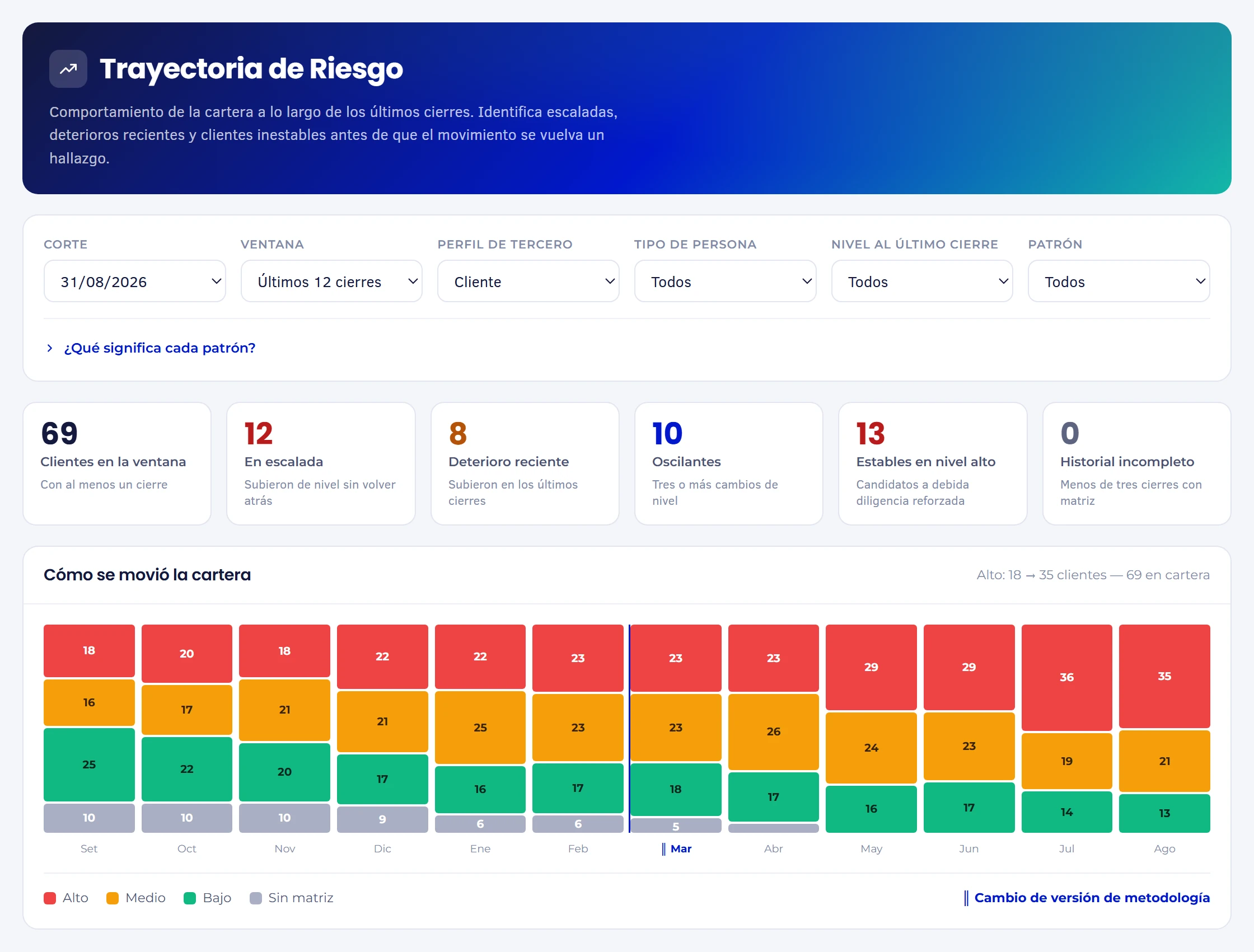
Risk Trajectory: clients escalating, recently deteriorating, oscillating and stable at the high level, and the portfolio by risk level over twelve closings View the full screen (opens in a new tab)

How your portfolio moved

Twelve risk-matrix closings in a single view: how many clients moved to high risk, how many keep escalating without stepping back, and from which closing a new methodology applies.

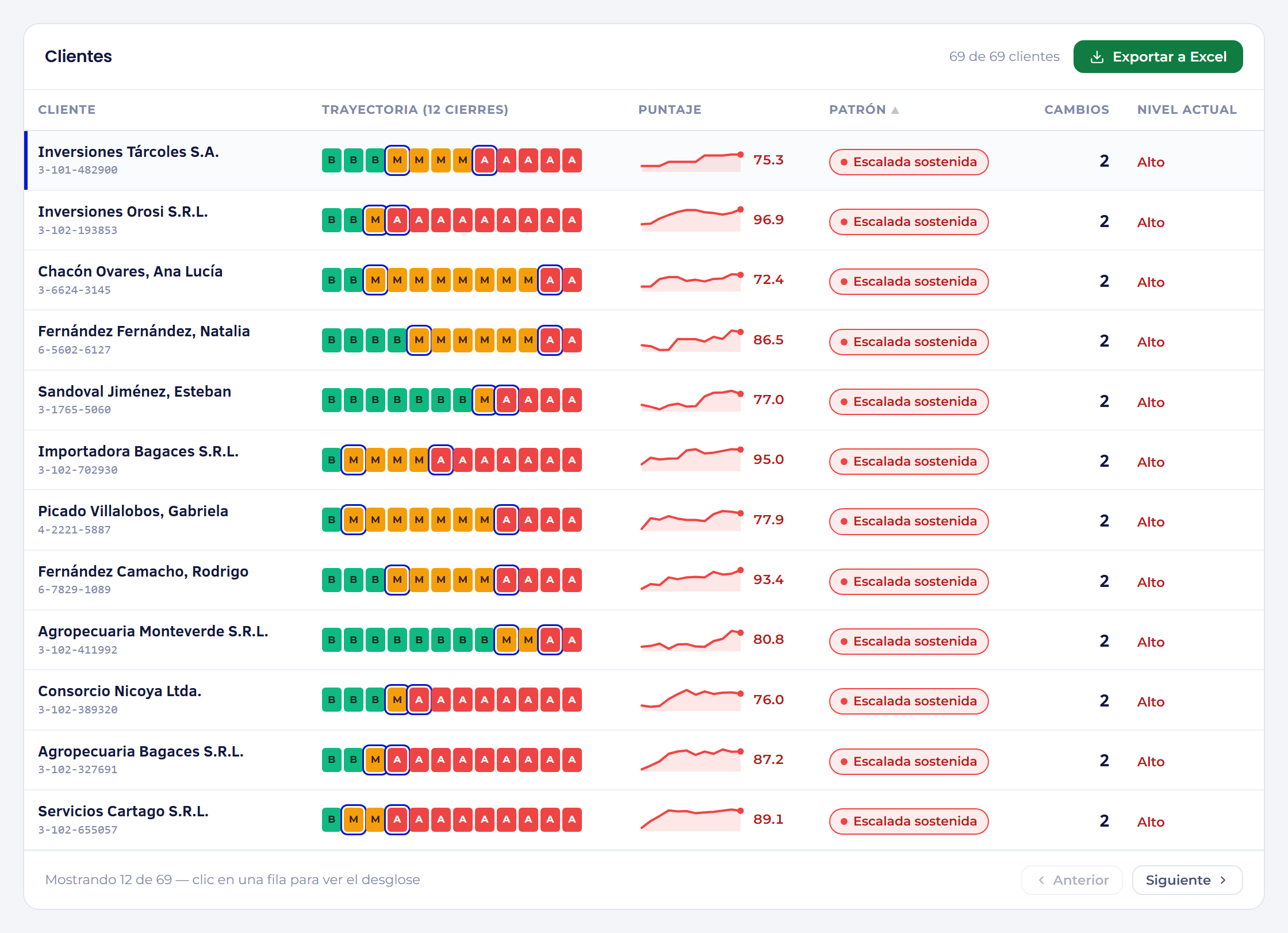
Client list with each client's twelve-closing trajectory, score, pattern and current risk level View the full screen (opens in a new tab)

Who to look at today

Every client with their twelve closings and a pattern that sets the priority: sustained escalation, recent deterioration, oscillating, or stable at the high level, a candidate for enhanced due diligence. The list exports to Excel in one click.

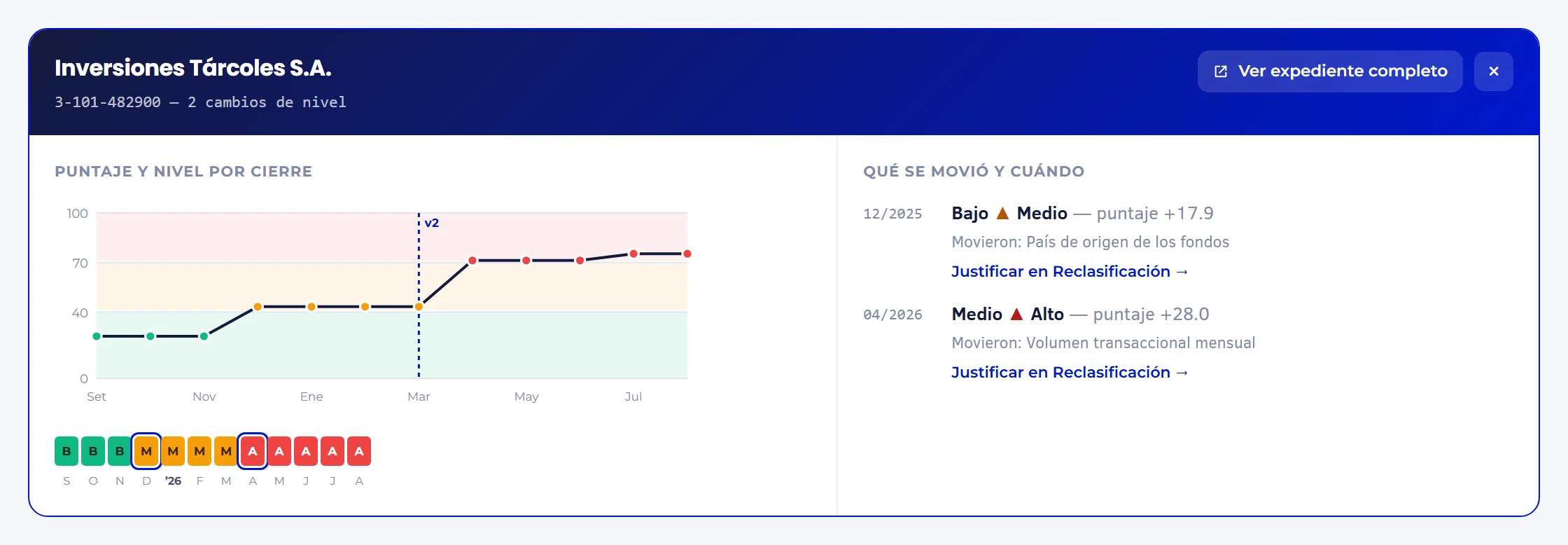
Client detail: the score at each closing with the methodology change marked, and every level change with the subfactor that drove it View the full screen (opens in a new tab)

What moved each client

The score at every closing, the subfactor that changed the level, and in which month. Each move opens its justification in Client Reclassification.

AML Monitoring

Snap Compliance screens with fictitious data.

FATF Recommendations

Where each FATF Recommendation is met in Costa Rica

How Costa Rica implements each FATF Recommendation that falls on institutions and professionals: first, what Law 7786 and CONASSIF 12-21 require of an article 14 financial institution; then, of the other obligated entities.

Swipe to see all columns

Recommendation What is required Legal basis
Financial institutions · article 14 Banks, finance companies, supervised cooperatives, mutuals, brokerages, investment funds, pension fund operators, insurers and the companies in their financial groups. Regulation: CONASSIF 12-21.
R.1 Assessing risks and applying a risk-based approach Document a self-assessment of ML/TF/PF risk across customers, countries, channels, products and services, using the latest National Risk Assessment as an input and showing results at least once a year. Each customer is rated, at a minimum, as high, medium or low risk. CONASSIF 12-21, arts. 24-25 · DE 36948, art. 14
R.6 Targeted financial sanctions related to terrorism and terrorist financing Continuously monitor the UN Security Council terrorist lists and, on a match, immediately freeze or immobilize the designated party's products and assets without prior notice, and report the result to the FIU within 24 hours at most. It also applies to articles 15, 15 bis and 15 quater. Ley 7786, art. 33 bis
R.7 Targeted financial sanctions related to proliferation The same monitoring and immediate freezing obligation applies to the Security Council lists on financing the proliferation of weapons of mass destruction. Ley 7786, art. 33 bis
R.9 Financial institution secrecy laws Banking, securities or tax secrecy does not prevent handing information to the authorities investigating these crimes, and requests from judges are met immediately. Ley 7786, arts. 17 y 32
R.10 Customer due diligence Identify and reliably verify the customer, its beneficial owner and the source of funds, with no anonymous or fictitious accounts, applying simplified or enhanced due diligence according to risk. Information is updated according to that risk, at least every 60 months, drawing on SUGEF's CICAC. Ley 7786, arts. 16 y 16 bis · DE 36948, arts. 14-20 · CONASSIF 12-21, arts. 27-37
R.11 Record keeping Keep customer and transaction records for at least five years —twice as long in certain cases, such as when a suspicious transaction was reported. Cash transactions and cross-border transfers of US$10,000 or more, single or adding up within the month, are recorded and reported to the superintendency within 20 calendar days after month-end. Ley 7786, arts. 16 y 20-23 · DE 36948, art. 21 · CONASSIF 12-21, arts. 38 y 53-55
R.12 Politically exposed persons Identify PEPs as defined in the general regulation, have general management approve the relationship, and treat them as PEPs during their term and for up to eight years afterwards; presidents or heads of state, indefinitely. DE 36948, arts. 22-24 · CONASSIF 12-21, art. 39
R.13 Correspondent banking The board approves every relationship with foreign correspondents and financial counterparties, after gathering information on their business, reputation, supervision and sanctions. Shell correspondents are prohibited, and each relationship is reassessed at least once a year. CONASSIF 12-21, art. 44
R.15 New technologies Assess the risk before launching new products, services, business practices, channels or technologies, with board approval. CONASSIF 12-21, art. 26
R.16 Payment transparency Every wire transfer, domestic or cross-border and of any amount, must carry the originator's name and identification, the beneficiary's name, and the account —or a unique reference— of both. The institution defines when to execute, reject or suspend one that arrives incomplete. CONASSIF 12-21, art. 52 · DE 36948, art. 33
R.17 Reliance on third parties Relying on a third party to identify the customer and the beneficial owner is not allowed: the institution is solely and directly responsible, unless the third party is a supervised entity in its own Costa Rican financial group or conglomerate. CONASSIF 12-21, art. 31
R.18 Internal controls and foreign branches and subsidiaries A compliance program with a committee chaired by a board member, a full-time principal and deputy compliance officer —unless an adjustment is authorized—, internal audit with an annual program, an annual external ML/TF/PF audit and annual training, applied in foreign branches and subsidiaries too. Ley 7786, arts. 26-27 · CONASSIF 12-21, arts. 6-23, 32 y 58
R.19 Higher-risk countries Enhanced due diligence for customers and transactions linked to countries the FATF lists as high-risk. Failing to apply these controls is sanctioned. CONASSIF 12-21, arts. 25 y 29 · Ley 7786, art. 81
R.20 Reporting of suspicious transactions Watch for transactions outside the customer's usual pattern, with systems that alert when activity exceeds the declared profile, and report every suspicious transaction, including attempts, immediately and confidentially to the ICD's FIU through UIF Directo. Ley 7786, arts. 24-25 · DE 36948, arts. 34-36 · CONASSIF 12-21, arts. 46-50
R.21 Tipping-off and confidentiality No one may tell the customer or third parties that a report was filed. Reporting does not create administrative, civil or criminal liability unless willful misconduct or gross negligence is proven. Ley 7786, arts. 18 y 25 · CONASSIF 12-21, art. 48
R.26 Regulation and supervision of financial institutions SUGEF, SUGEVAL, SUGESE and SUPEN supervise their institutions' compliance and can impose sanctions, under CONASSIF's direction. Ley 7786, arts. 14, 28 y 81 · Ley 7732, arts. 169 y 171
R.35 Sanctions Fines of 0.5% to 2% of equity for failures in due diligence, record keeping, PEPs, suspicious transaction reporting or the compliance program, among others, and for dealing with article 15, 15 bis or 15 quater businesses that lack a current registration. Final sanctions form a public-interest list. Ley 7786, art. 81
Articles 15, 15 bis, 15 ter and 15 quater Financial activities outside the supervised system, DNFBPs, notaries and virtual asset service providers.
R.14 Money or value transfer services Legal persons that carry out currency exchange, systematic fund transfers or cross-border remittances without being supervised institutions register with SUGEF —which does not license them to operate— as single-purpose companies, and comply with SUGEF 13-19. Ley 7786, art. 15 · SUGEF 11-18 · SUGEF 13-19
R.15 New technologies Virtual asset service providers register with SUGEF, document their risk assessment and apply due diligence, the transfer rules and suspicious transaction reporting. Ley 7786, art. 15 quater · Ley 10961
R.22 DNFBPs: Customer due diligence Casinos, real estate agents, precious metals and stones dealers, lawyers, notaries, accountants and the other article 15 bis businesses meet the due diligence and record-keeping obligations of article 15. Ley 7786, arts. 15 bis y 15 ter · DE 41016 · SUGEF 13-19
R.23 DNFBPs: Other measures Those same businesses report suspicious transactions to the FIU and apply the high-risk country and confidentiality controls. Ley 7786, arts. 15 bis, 15 ter y 25 · DE 41016, arts. 29-30
R.28 Regulation and supervision of DNFBPs SUGEF registers and supervises the article 15 bis DNFBPs on a risk basis. The National Notary Directorate supervises notaries. Ley 7786, arts. 15 bis, 15 ter y 81 · DE 41016, art. 6 · SUGEF 11-18 y 13-19
Transparency and financial intelligence Rules that reach every legal person, and the unit that receives the reports.
R.24 Transparency and beneficial ownership of legal persons Legal persons declare their beneficial owners in the Central Bank's RTBF from a 15% stake, and obligated persons may not keep companies with bearer shares as customers. Ley 9416, arts. 5-14 · DE 44390-H · Ley 7786, art. 16 f)
R.25 Transparency and beneficial ownership of legal arrangements In a trust (fideicomiso), each party —settlor, trustee, beneficiary and protector, if any— counts as a beneficial owner, and the trust is registered in the RTBF. Ley 9416, art. 5 · DE 44390-H, arts. 10 y 18
R.29 Financial intelligence units The ICD's FIU receives and analyzes reports, refers its findings to the Public Prosecutor's Office and exchanges information with its foreign counterparts. Ley 7786, arts. 123-125

Only the Recommendations that fall on institutions and professionals are listed. The rest —criminalization, powers of the authorities, international cooperation— are the State's responsibility.

Titles as they appear in the FATF Recommendations.

Around the AML program

Corporate governance, criminal liability and personal data

Corporate governance and corporate criminal liability

Supervised institutions follow the Corporate Governance Regulation (Acuerdo CONASSIF 4-16, formerly SUGEF 16-16). Separately, Law 9699 makes legal persons criminally liable for bribery, foreign bribery and other offenses, and since the Law 10373 reform, for money laundering too. Adopting a crime prevention model is optional, but it is one of the circumstances that allow the judge to reduce the penalty by up to 40%, and the company is not liable if a subordinate or an intermediary committed the offense by fraudulently circumventing that model.

Explore Fortaleza GRC

Personal data protection

Due diligence collects data on customers and beneficial owners. Its processing is governed by Law 8968 and its regulation (DE 37554-JP), with PRODHAB as the supervisory authority.

Frequently asked questions

What people ask us most about Law 7786

Who are the obligated entities under Law 7786 in Costa Rica?

The law splits them across five articles. Article 14 covers the institutions supervised by SUGEF, SUGEVAL, SUPEN and SUGESE —banks, finance companies, supervised cooperatives, mutuals, brokerages, pension fund operators and insurers— and every company in their financial groups. Article 15 covers financial activities outside the supervised system, such as remittances; 15 bis, DNFBPs; 15 ter, notaries; and 15 quater, virtual asset service providers. That article determines which rules your organization follows and who supervises it.

Are Law 8204 and Law 7786 the same law?

Yes. Law 8204 comprehensively reformed Law 7786, which is why many still call it by that number. The law in force is Law 7786 with its later amendments; one of the most recent, Law 10961 of 2026, added virtual asset service providers as obligated entities. That is why a compliance program should be checked against the current text, not an earlier version.

What is the difference between Acuerdo CONASSIF 12-21 and Acuerdo SUGEF 13-19?

CONASSIF 12-21 —formerly Acuerdo SUGEF 12-21— is the AML regulation for article 14 financial institutions, applied by SUGEF, SUGEVAL, SUPEN and SUGESE. SUGEF 13-19 governs those who register with SUGEF under articles 15 and 15 bis, such as remittance companies, real estate businesses, casinos and pawnshops. Snap Compliance's Customer Due Diligence Toolkit for Costa Rica is built on both, so your team does not start from a blank page.

What must an article 14 institution's compliance program include?

Under CONASSIF 12-21: a compliance committee chaired by a board member; a principal compliance officer and a deputy; internal audit with an annual program and an annual external ML/TF/PF audit; a risk self-assessment with results at least once a year; risk-based due diligence and monitoring; and annual training. With Fortaleza AML, Snap Compliance implements that program with your team and organizes the evidence your supervisor will ask for.

How is a suspicious transaction reported in Costa Rica?

Immediately and confidentially to the ICD's Financial Intelligence Unit, including attempted transactions. Article 14 institutions report through UIF Directo; those under articles 15 and 15 bis, through UIF Reportes. No one may tip off the customer, and the reporting party incurs no liability unless willful misconduct or gross negligence is proven. Snap Compliance's AML monitoring compares every transaction with the customer's profile and keeps every alert with its audit trail, so your compliance officer can decide whether to report.

Which transactions must be recorded from US$10,000?

For article 14 institutions, CONASSIF 12-21 spells it out: cash transactions and transfers to or from abroad of US$10,000 or more, or the equivalent, are recorded whether they are a single transaction or add up to that amount within a calendar month, and are reported to the superintendency within 20 calendar days after each month ends. Snap Compliance's transaction monitoring detects structuring: transactions split up to stay under the threshold.

What does Law 7786 require regarding UN sanctions lists?

Monitoring them continuously. If a customer matches a person or entity designated by the Security Council for terrorism or for proliferation of weapons of mass destruction, the institution immediately freezes or immobilizes their products and assets, without prior notice, and reports the result to the FIU within 24 hours at most. Snap Compliance's Scan Agent checks those lists along with the OFAC, European Union and United Kingdom lists, updated daily.

How is the beneficial owner identified in Costa Rica?

It is the natural person who ultimately owns or controls the customer, or on whose behalf a transaction is carried out. Legal persons declare it in the Central Bank's Transparency and Beneficial Ownership Registry from a 15% stake, and the law bars entities under articles 14, 15, 15 bis and 15 quater from having companies with bearer shares as customers. With Snap Compliance's Scan Agent, the customer and its beneficial owners are screened against sanctions lists, PEPs and adverse media in a single check.

What happens if a financial institution breaches Law 7786?

Its superintendency can fine it between 0.5% and 2% of its equity for failures in due diligence, record keeping, PEP controls, suspicious transaction reporting or the compliance program, among others, depending on the severity, the harm and any repeat offense. Final sanctions are kept on a public-interest list, and Law 9699 also makes the legal person criminally liable for money laundering. That is why the program has to work, and has to be able to prove it.

What must a system do to comply with Law 7786?

What the rules require on an ongoing basis: continuously monitor the UN Security Council lists; rate every customer at least as high, medium or low risk; alert when a customer's transactions exceed the declared profile; and keep the evidence for five years, or ten in certain cases. Snap Compliance's Compliance OS brings those tasks together —plus PEP and adverse media screening— on a single platform: your team decides and the platform does the heavy lifting.

Would your program withstand a supervisor's review today?

We review with you where your institution stands against these rules and what it still needs to demonstrate compliance.

Talk to a specialist

Free self-assessment · Chile

How ready is your organization for Chile's Law No. 21.719?

Answer the questions that apply to your organization and see its blocking findings, its gaps by domain and its estimated exposure, with an action plan in Word. Available in Spanish.

16 domains · 45 to 90 minutes · save and resume 64 days until enforcement