Snap Compliance
Contact us

Language

EN ES PT
Start free
Law 19.913 · UAF · Chile

Comply with Law 19.913 with every client identified and every UAF report on time

For banks, insurers, brokers, pension fund administrators, cooperatives, fintechs, notaries, real estate brokers, car dealers and every other article 3 entity: what the law and UAF Circular No. 62 require, what is at stake if you fall short, and how Snap Compliance turns it into a program backed by evidence.

At a glance

What it governs

AML/CFT/CPF

It creates the Financial Analysis Unit, requires reporting suspicious transactions and recording cash transactions, and makes money laundering a crime (art. 27).

Who must comply

Article 3 entities

From the financial system to notaries, registrars, real estate brokers, casinos, car dealers, jewelers and the firms in the Fintech Law registers: 55 economic activities, according to the UAF.

Who supervises

UAF · CMF

The UAF issues the instructions, supervises with a risk-based approach and imposes sanctions. The CMF adds its own rules for the entities it oversees; its Circular No. 2368 of February 2026 aligned those for banks, non-bank card issuers and cooperatives with Circular No. 62.

Key milestone

June 1, 2025

Circular No. 62 came into force, bringing the UAF's instructions into a single rule and repealing 24 earlier circulars, including No. 49. The law itself has been in force since December 2003.

Read the official text: Ley 19.913

What it requires

What Law 19.913 requires

The law sets the duties and UAF Circular No. 62 explains how to meet them. These obligations apply to every article 3 entity; the CMF adds its own for the entities it supervises.

Registration and compliance officer

Register with the UAF (art. 40) and appoint an officer responsible for dealing with it (art. 3). Circular No. 62 requires a senior position with independence, resources and access to every transaction (ch. B).

Customer due diligence

Identify and know the client before or during the relationship, in occasional transactions from USD 3,000 and whenever there is suspicion, with a client file updated at least once a year and enhanced measures for high risk (Circular No. 62, ch. F).

Beneficial ownership

Ask every legal person or arrangement client to declare its beneficial owners: whoever holds 10% or more of the capital or votes, or exercises effective control. A 40-business-day delay is a red flag (ch. G).

Politically exposed persons

Determine whether the client or its beneficial owner is a PEP, until at least one year after leaving office and including close family, and apply senior management approval, source of wealth and funds, and enhanced monitoring (ch. H).

Suspicious transaction reports (ROS)

Report to the UAF, as soon as possible and with no minimum amount, any unusual transaction or one with no apparent justification, without telling the client (arts. 3 and 6). A match with UN Security Council lists is reported immediately (art. 38 and ch. C).

Cash transaction reports (ROE)

Record cash transactions above USD 10,000 (art. 5) and report them: monthly for banks, quarterly for the rest of the financial sector and every six months for the non-financial sector, with a nil report if there were none (ch. D).

Five-year records

Keep the records of cash transactions, suspicious transactions —including those ruled out—, due diligence, PEPs and transfers for at least five years after the relationship ends, available to the UAF (art. 5 and ch. E).

Manual and training

A Prevention and Detection Manual approved by the highest governing body, updated at least every two years and given to all staff, plus annual training for every employee, with an attendance record (chs. J and L).

Consequences

What is at stake if you fall short

The UAF Director sets sanctions according to the offender's economic capacity and the seriousness and consequences of the act (art. 19): a warning or a fine of up to 800 UF for breaching its instructions; up to 3,000 UF for failing to keep the cash transaction record; and up to 5,000 UF for breaching article 3, such as failing to report suspicious transactions, or for withholding information the UAF requests (art. 20). If a breach of the same kind is repeated within twelve months, the fine can triple, and it can also reach the directors or representatives involved (art. 21). Tipping off a client about a report is a crime: imprisonment and a fine of 100 to 400 UTM (arts. 6 and 7).

How we help

How Snap Compliance helps

Due Diligence builds each client's file with document checklists and configurable forms, and scales the depth of diligence to its risk. Scan Agent checks clients and beneficial owners against sanctions lists —including the UN Security Council list—, PEPs and adverse media, and rescreens the portfolio periodically. AML Monitoring analyzes transactions daily against each client's profile, segments the portfolio by risk, keeps the full alert history with no limit and produces reports for the regulator, including the STR. Compliance Agent manages the obligations of Circular No. 62 as controls, assessments and action plans. Approving the manual and running the annual training remain your institution's job: Snap keeps the evidence in order.

Snap Compliance modules
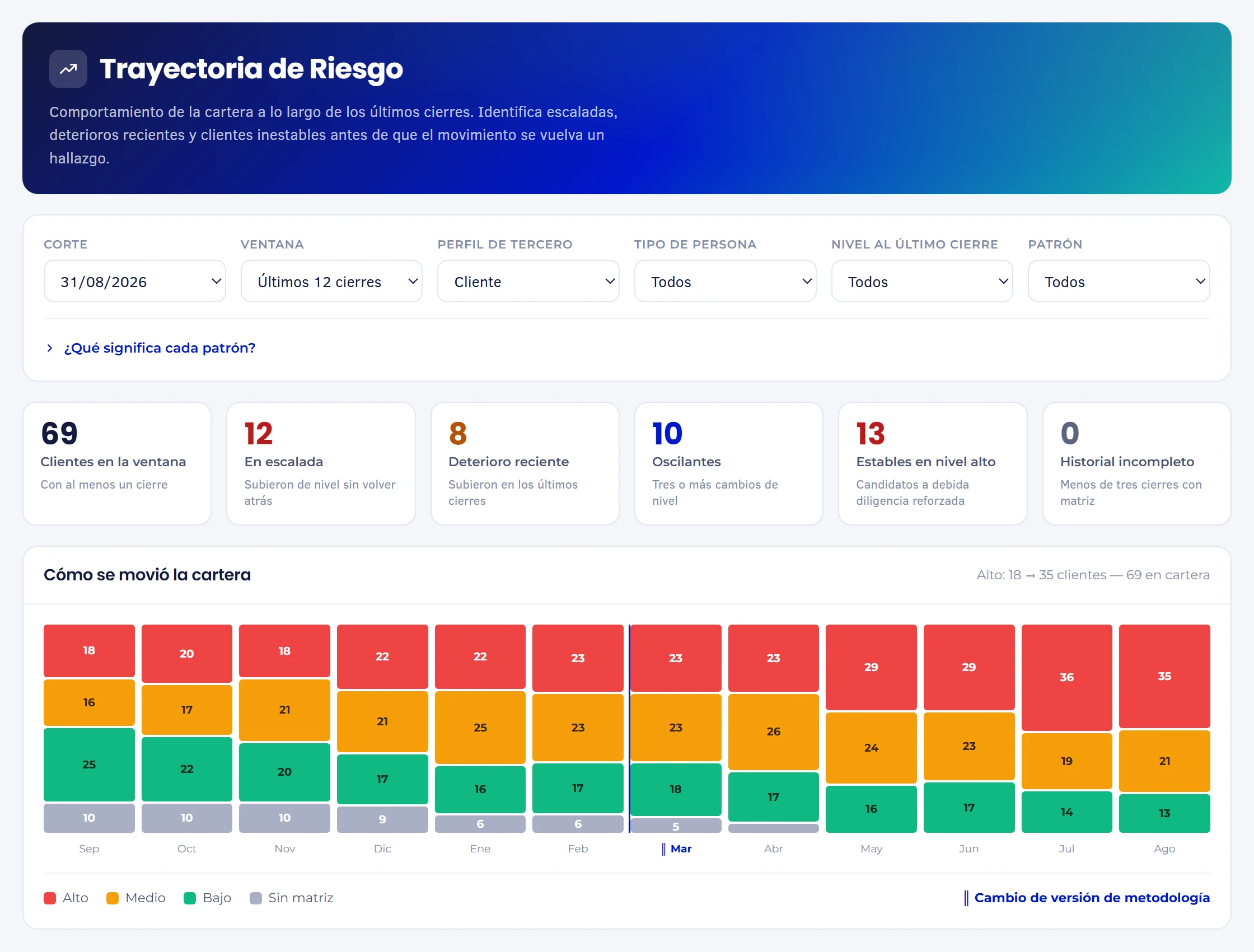
Risk Trajectory: clients escalating, recently deteriorating, oscillating and stable at the high level, and the portfolio by risk level over twelve closings

How your portfolio moved

Twelve risk-matrix closings in a single view: how many clients moved to high risk, how many keep escalating without stepping back, and from which closing a new methodology applies.
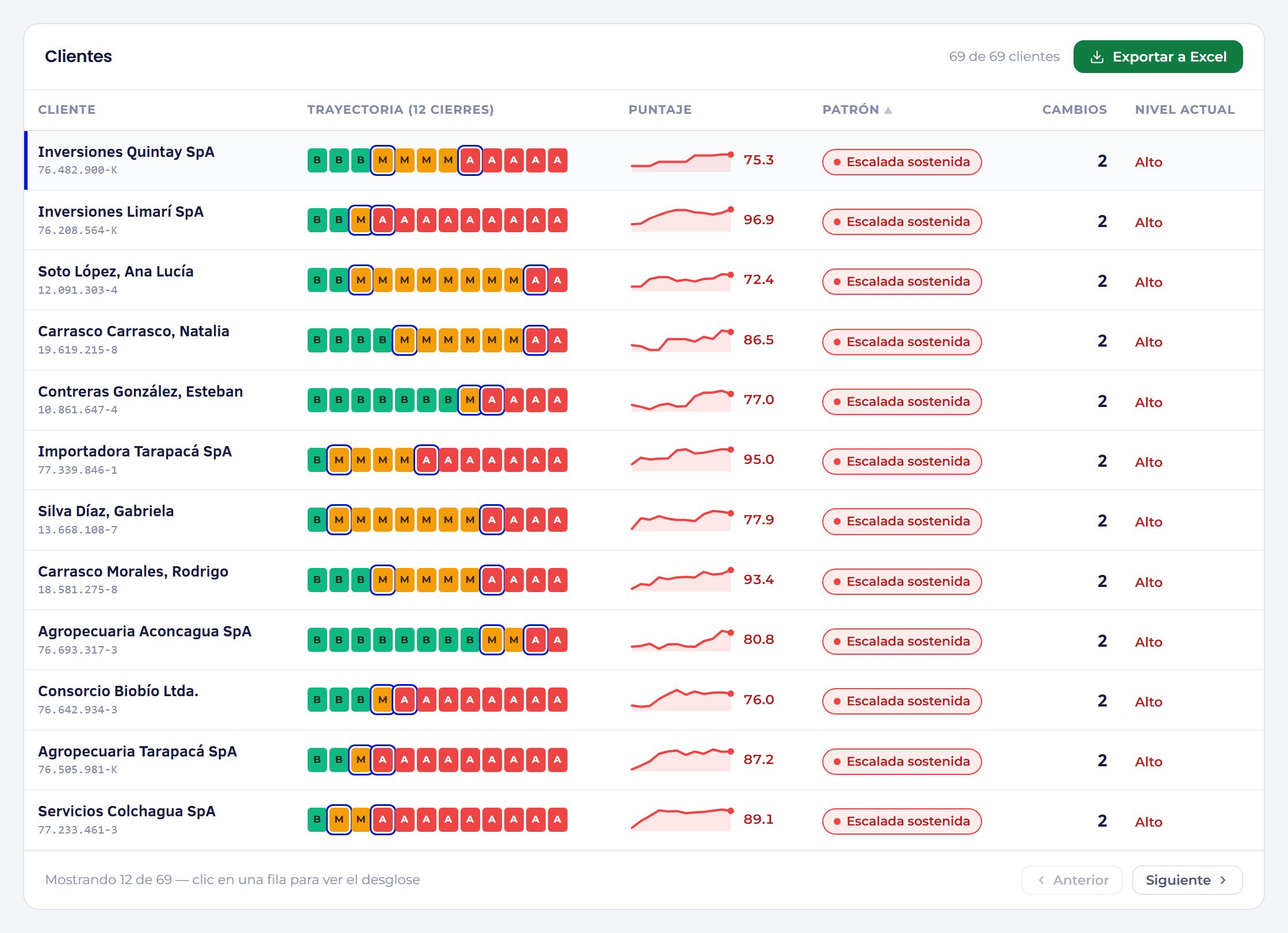
Client list with each client's twelve-closing trajectory, score, pattern and current risk level

Who to look at today

Every client with their twelve closings and a pattern that sets the priority: sustained escalation, recent deterioration, oscillating, or stable at the high level, a candidate for enhanced due diligence. The list exports to Excel in one click.
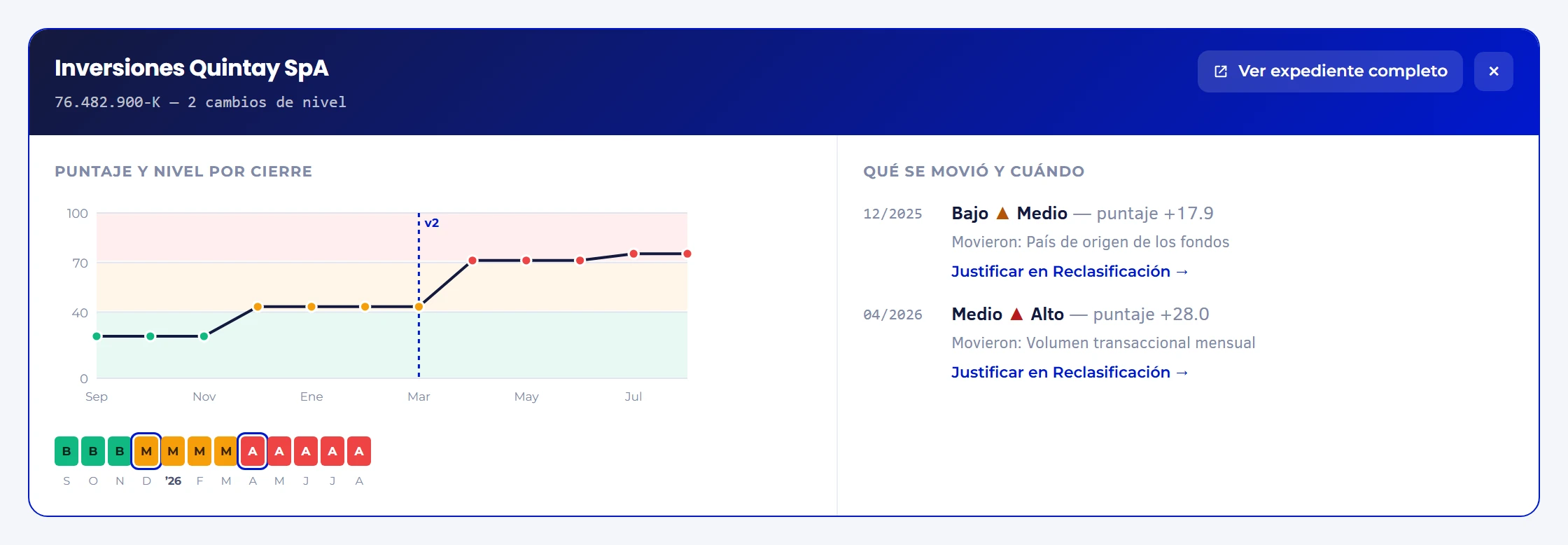
Client detail: the score at each closing with the methodology change marked, and every level change with the subfactor that drove it

What moved each client

The score at every closing, the subfactor that changed the level, and in which month. Each move opens its justification in Client Reclassification.

Snap Compliance screens with fictitious data.

Frequently asked questions about Law 19.913

Who are the obligated entities under Law 19.913?
The individuals and legal entities listed in its article 3: banks, card issuers, exchange houses, stockbrokers, fund administrators, insurers, pension fund administrators, savings and credit cooperatives, casinos, notaries, registrars, real estate brokers, car dealers and jewelers, among others; the UAF counts 55 activities. The firms in the Fintech Law registers are included too. All of them must register with the UAF (art. 40). With Due Diligence, every client is identified and has its risk calculated.
What does Chile's Financial Analysis Unit (UAF) do?
It is the public agency created by article 1 of Law 19.913 to prevent the financial system and other sectors from being used to launder assets or finance terrorism. It reports to the President through the Ministry of Finance. Under article 2, it receives and analyzes reports, issues instructions to obligated entities, supervises them with a risk-based approach, sanctions them and refers signs of crime to the Public Prosecutor's Office. AML Monitoring keeps ready the evidence it reviews.
What requirements must a compliance officer meet before the UAF?
Article 3 of Law 19.913 requires appointing an officer responsible for dealing with the UAF. Circular No. 62 requires a senior position, such as an area manager, with independence, human and technology resources and access to every transaction. The UAF will not register anyone convicted of laundering or its predicate offenses, nor its own former staff within six months, and a change of officer must be reported within ten business days. AML Monitoring gives the officer a dedicated management view.
What information does customer due diligence require under Circular No. 62?
Name or company name, ID document or tax ID with proof of incorporation, nationality and occupation or line of business, country of residence, address, contact details and the purpose of the relationship. It is collected before or during a permanent relationship, in occasional transactions from USD 3,000 and whenever there is suspicion. The client file is updated at least once a year, with enhanced measures for high risk and simplified ones for low risk. Due Diligence adjusts document requirements and depth to each client type.
From what ownership percentage is the beneficial owner identified in Chile?
From 10%. Circular No. 62 defines the beneficial owner as the individual who directly or indirectly holds 10% or more of the capital or voting rights of a legal person or arrangement, and anyone who, with less, exercises effective control. Every obligated entity requests the declaration on the UAF's standard form and verifies what is declared; a 40-business-day delay is a red flag for a suspicious transaction report. Scan Agent checks every beneficial owner against lists and news.
Who counts as a PEP for the UAF, and what measures apply?
Under Circular No. 62, PEPs are Chileans and foreigners who hold or have held prominent public functions, until at least one year after leaving office, together with their spouse, civil partner and relatives up to the second degree. The minimum list includes legislators, mayors, judges, ministers and executives of state-owned companies, among others. The UAF does not publish a PEP list: each entity must detect them and apply senior management approval and source of funds and wealth checks. Scan Agent identifies PEPs in its sources.
How and when is a suspicious transaction reported to the UAF?
With no minimum amount or fixed schedule: as soon as possible after detection, through the UAF's channel and with the supporting documents. Any unusual transaction, or one with no apparent economic or legal justification, is suspicious (art. 3). The analysis must be documented, and the case record, including cases ruled out, is kept for five years. Tipping off the client is a crime (arts. 6 and 7), and a UN list match is reported immediately. AML Monitoring alerts you when a client moves outside its profile.
How often is the Cash Transaction Report (ROE) sent to the UAF?
It depends on the sector: banks send it monthly; the rest of the financial sector, quarterly; and the non-financial sector, every six months, always within the first ten business days of the month after the period. It covers every cash transaction above USD 10,000 or its peso equivalent, including cash deposits into the entity's own accounts. If there were none, a nil report is filed, and an ROE rejected for errors counts as not filed. AML Monitoring takes in transactions daily from your core systems.
What must the Prevention and Detection Manual contain, and how often must staff be trained?
Circular No. 62 requires a manual approved by the highest governing body, updated at least every two years and given to all staff with proof of delivery. It covers internal organization, due diligence, beneficial ownership and PEP policies, the risk policy, detecting and reporting suspicious transactions, and screening against UN lists and high-risk countries. Every employee is trained once a year, with an attendance record. Compliance Agent tracks its controls and action plans.
What fines does the UAF impose for breaching Law 19.913?
Article 20 sets a warning or a fine of up to 800 UF for breaching UAF instructions, up to 3,000 UF for failing to keep the cash transaction record and up to 5,000 UF for failing to report suspicious transactions. With two or more breaches of the same kind within twelve months, the fine can triple, and it can reach the directors or representatives involved (art. 21). The UAF scales the sanction to economic capacity and seriousness (art. 19). AML Monitoring keeps the evidence of every alert and its resolution.

Would your program withstand a supervisor's review today?

We review with you where your institution stands against these rules and what it still needs to demonstrate compliance.

Talk to a specialist

Free self-assessment · Chile

How ready is your organization for Chile's Law No. 21.719?

Answer the questions that apply to your organization and see its blocking findings, its gaps by domain and its estimated exposure, with an action plan in Word. Available in Spanish.

16 domains · 45 to 90 minutes · save and resume 46 days until enforcement