Strict liability
The institution is liable for funds taken from its clients' accounts, regardless of fault (Law 7472, art. 35, as amended by Law 10.889).

Central America and the Caribbean
Mexico and South America
Laws and regulations by countryLaw 10.889 makes your institution liable for funds taken from your clients, except for the legal exemptions. Find out for free where you stand and get the 22 artifacts to comply.
Free · Save and resume whenever you like · Results when you finish
The self-assessment and the toolkit documents are in Spanish, the language of the regulation.
What changed
Law 10.889 has been in force since April 22, 2026, and SUGEF Regulation 5-26 since September 11, 2026. When a client claims a transaction they did not authorize, your institution is liable even without fault, and it is the one that must prove its controls worked.
The institution is liable for funds taken from its clients' accounts, regardless of fault (Law 7472, art. 35, as amended by Law 10.889).
In administrative and judicial proceedings, the burden of proof is reversed in favor of the consumer (Law 10.889, arts. 6 and 7).
Self-fraud, intent, or a transfer between accounts of the same holder, with evidence specific to the case (Law 10.889, art. 3, para. b).
The claim clock
On receipt
A tracking code with date and time, and an immediate block on the product (art. 4).
Day 30
Decide the claim, in calendar days; a single extension of up to 10 business days, notified in advance (art. 3).
If upheld
Credit the funds within 10 calendar days and remove interest and charges (art. 3).
If decided late
Compensation of one base salary to the client, even if the claim is not upheld (art. 5).
Day 120
The institution can no longer decide and must return the funds within 10 calendar days (art. 5).
An unauthorized transaction that happens after the claim is the institution's responsibility (art. 3).
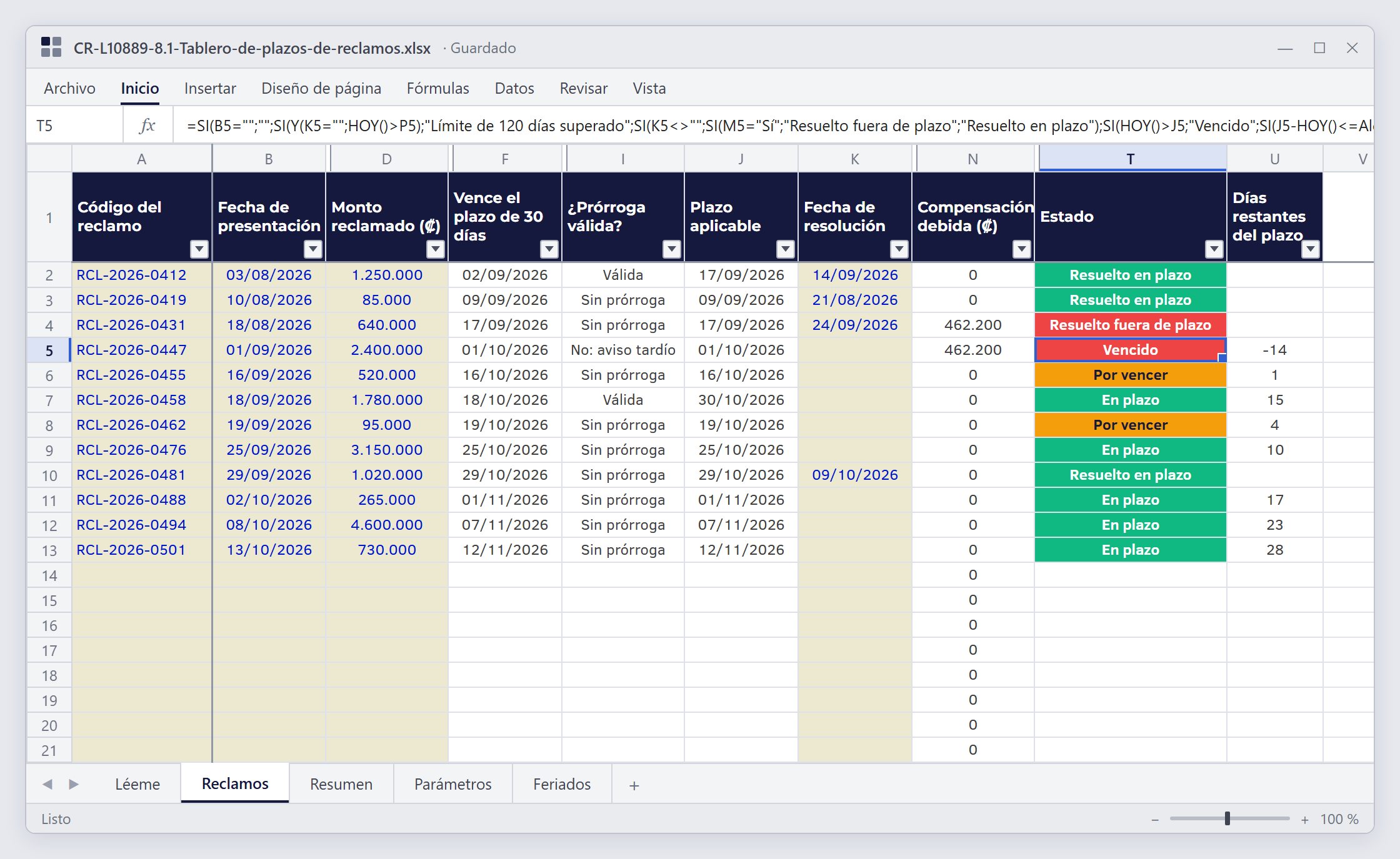
The claim deadline dashboard (toolkit artifact 8.1) calculates the five deadlines of each claim and flags in red the ones about to expire. Sample data.
SUGEF Regulation 5-26
Before rejecting a claim, the institution must prove it meets the regulation's minimum controls and that its systems were not breached (Law 10.889, art. 3; SUGEF Regulation 5-26, art. 8).
A strategy against cyber fraud, based on a risk assessment and approved by the Board (art. 3).
A statistical record of each case, with its typology, channel and authentication factors, available to SUGEF (art. 4).
Monitoring of transaction patterns, devices and behavior, with confirmation before an atypical transaction goes through (art. 12).
Two-factor authentication to log in, for risky transactions and for self-service (art. 13).
Notifications in under a minute, with evidence of each one and no shortened links in emails (arts. 15 and 16).
A threshold, set on a cost-benefit basis, below which the institution refunds without a detailed investigation (art. 11).
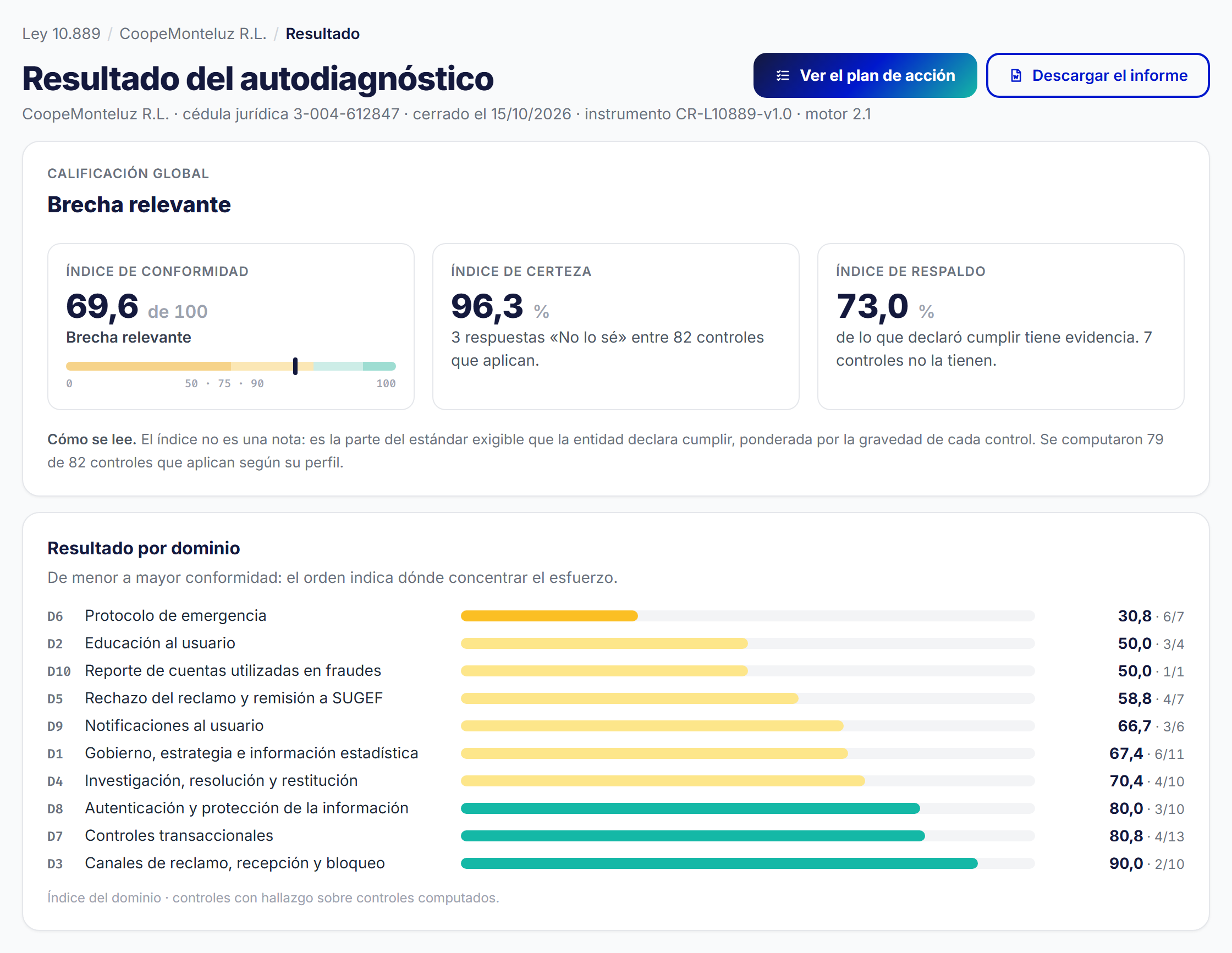
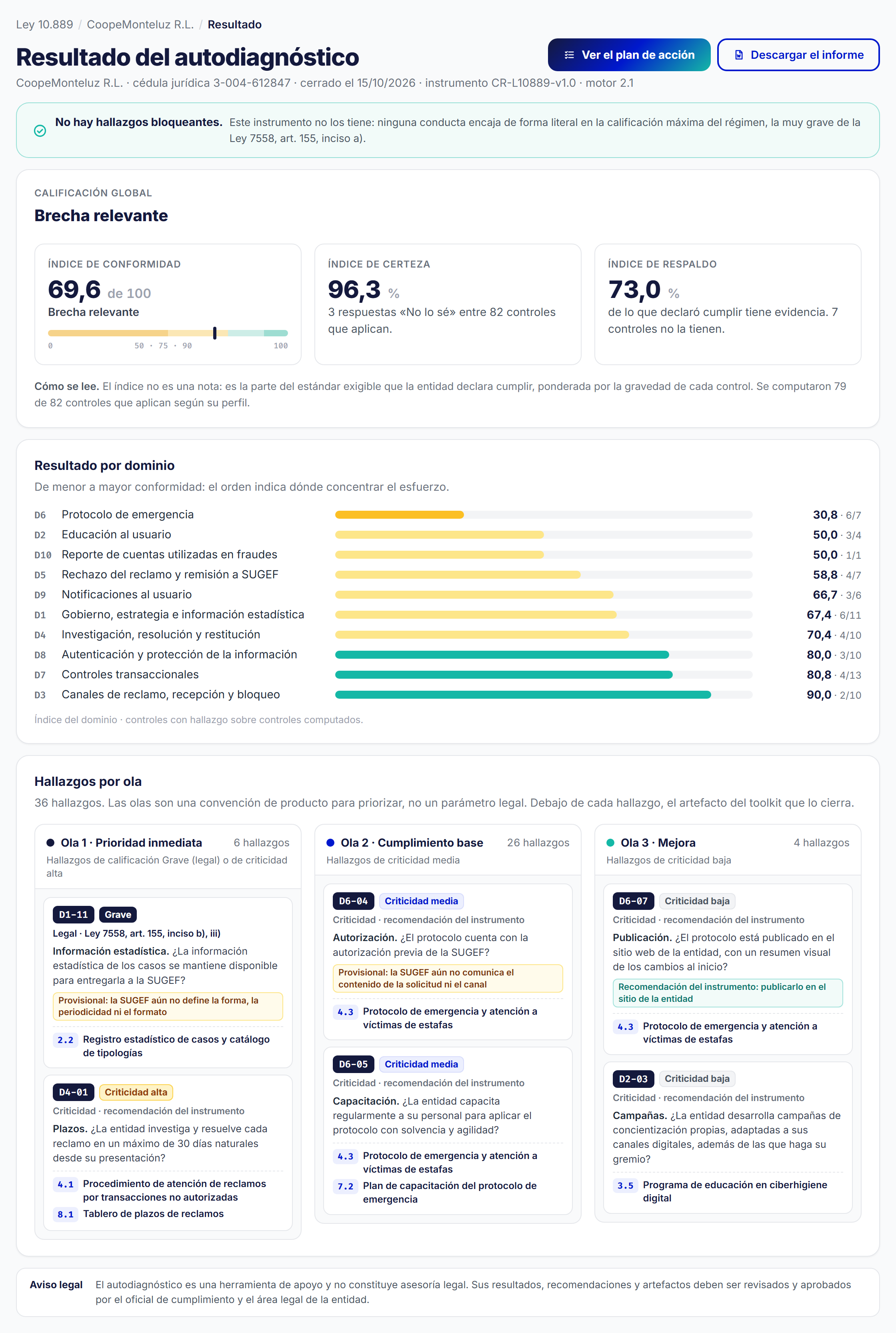
Free self-assessment
98 questions: 11 for the initial profile and 87 across 10 domains, written from the literal text of the law and the regulation. Each question tells you which area of your institution has the answer, so you can save, check and resume.
Take the free self-assessmentIt does not estimate fines, because the regulation does not allow that figure to be built, and it does not review documents.
The toolkit
You do not start from a blank page. Each document brings the obligation, its article and the fields your institution fills in: 15 Word documents and 7 Excel workbooks.
Emergency protocol (4.3) · Claims procedure (4.1) · Claim form (4.2) · Deadline dashboard in Excel (8.1)
Anti-fraud strategy (3.1) · Below-threshold refund policy (3.2) · Threshold cost-benefit analysis (6.2) · Model resolution (7.1)
Rejection and referral to SUGEF and the OIJ procedure (4.4) · Notifications (4.5) · Authentication and information protection (3.3)
Transaction monitoring and preventive blocks (3.4) · Risk assessment by channel (6.1) · Channel inventory (2.1) · Statistical record (2.2)
Cyber hygiene program (3.5) · Training plan (7.2) · Account reporting (4.6) · Monitoring log (8.2)
It also includes the self-assessment guide (1.1), the implementation guide (G.1) and the catalog with the traceability of each control (C.1).
A date that did not wait
The law gave six months from its entry into force to have in operation the protocol that all your staff apply when a client says they were defrauded, or are being defrauded. The protocol requires SUGEF's prior authorization and an update at least once a year (Law 10.889, art. 11 and Transitional Provision II; SUGEF Regulation 5-26, art. 10). Artifact 4.3 brings the eight immediate-response steps, aligned with the regulation's controls.
Price
USD 199
One-time payment
22 artifacts (15 Word and 7 Excel) · implementation guide · control-by-control traceability
Self-assessment: always free
Get the toolkitThe toolkit and the self-assessment are support tools and do not constitute legal advice. Each artifact must be reviewed, adapted and approved by the institution's compliance officer and legal team before use.
How it works
Take the self-assessment
Free, in one session; each question tells you which area answers it.
Get the toolkit
Each finding tells you which artifact closes it.
Adapt and approve
You fill in your institution's fields, and your compliance officer and legal team approve it.
On the platform
The toolkit gives you the documentary framework. To run it, the Corporate Governance Management module (Compliance Agent) tracks each obligation of Law 10.889 and SUGEF Regulation 5-26 with its control, owner, deadline and evidence, and shows the Board where the institution stands. Technical controls, such as two-factor authentication or notifications, live in your digital channels; the platform governs their compliance.
Corporate Governance Management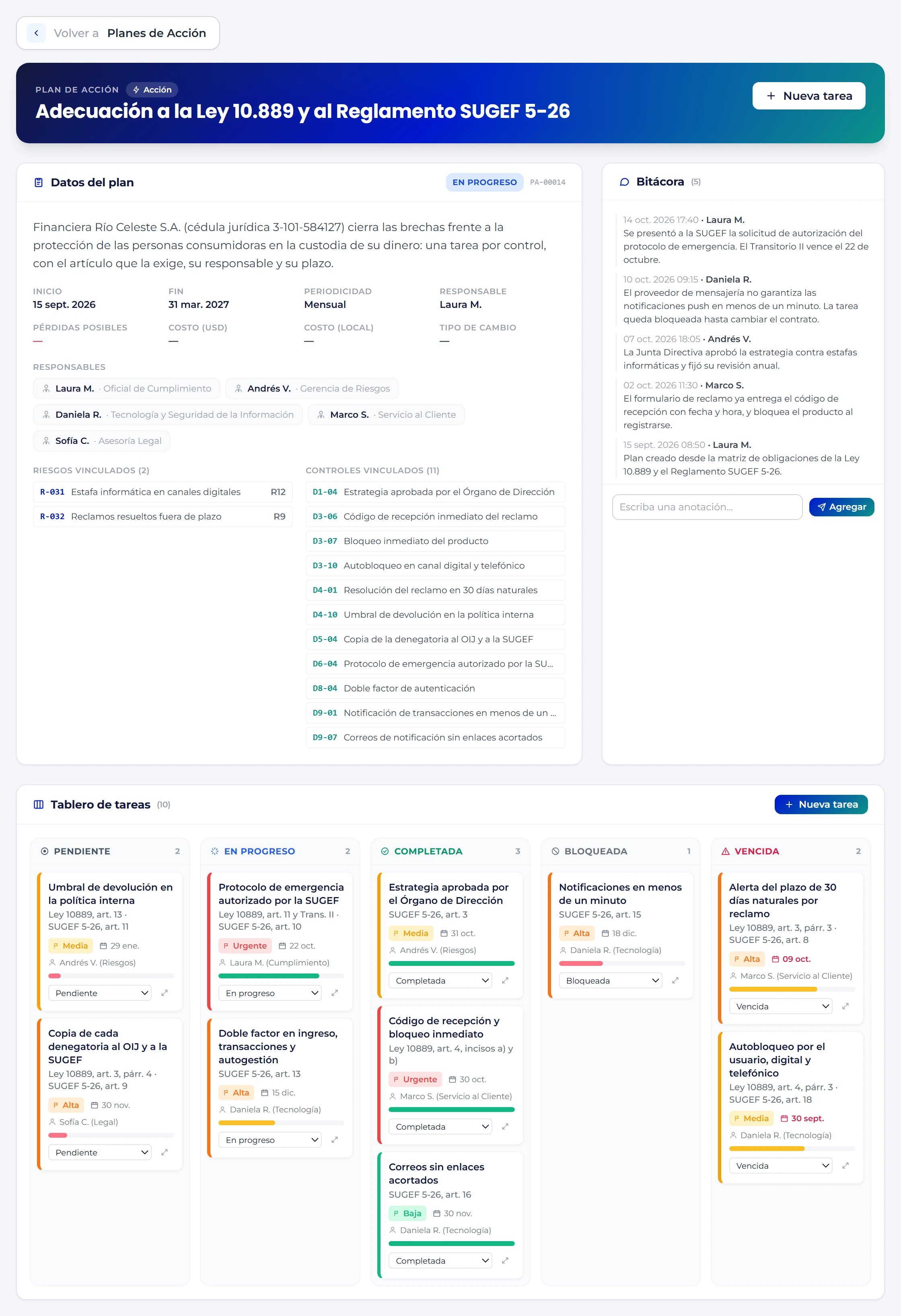
Why trust this toolkit
Every citation is literal and was checked against the official text in force: SINALEVI and La Gaceta.
Where the regulation does not define something, we tell you. Those readings are marked as recommendations, and the decision belongs to your compliance officer and legal team.
We do not make up figures. If the regulation does not allow a fine to be calculated, the assessment does not estimate it.
Visible cut-off date: October 15, 2026. Log 8.2 records what SUGEF has not yet issued and the constitutional challenges pending against the law.
The toolkit and the self-assessment are support tools and do not constitute legal advice. Each artifact must be reviewed, adapted and approved by the institution's compliance officer and legal team before use.
Lucia
Virtual assistant · Snap Compliance
Before we start
I'm Lucia. I'll be assisting you here and helping you with whatever you need from Snap Compliance.
We process your data in accordance with the applicable laws and regulations.